
Temple & Family HistoryFrom Danghyang Nirartha to Griya Gede Mas
Sejarah Griya Gede Mas
Mas, Ubud
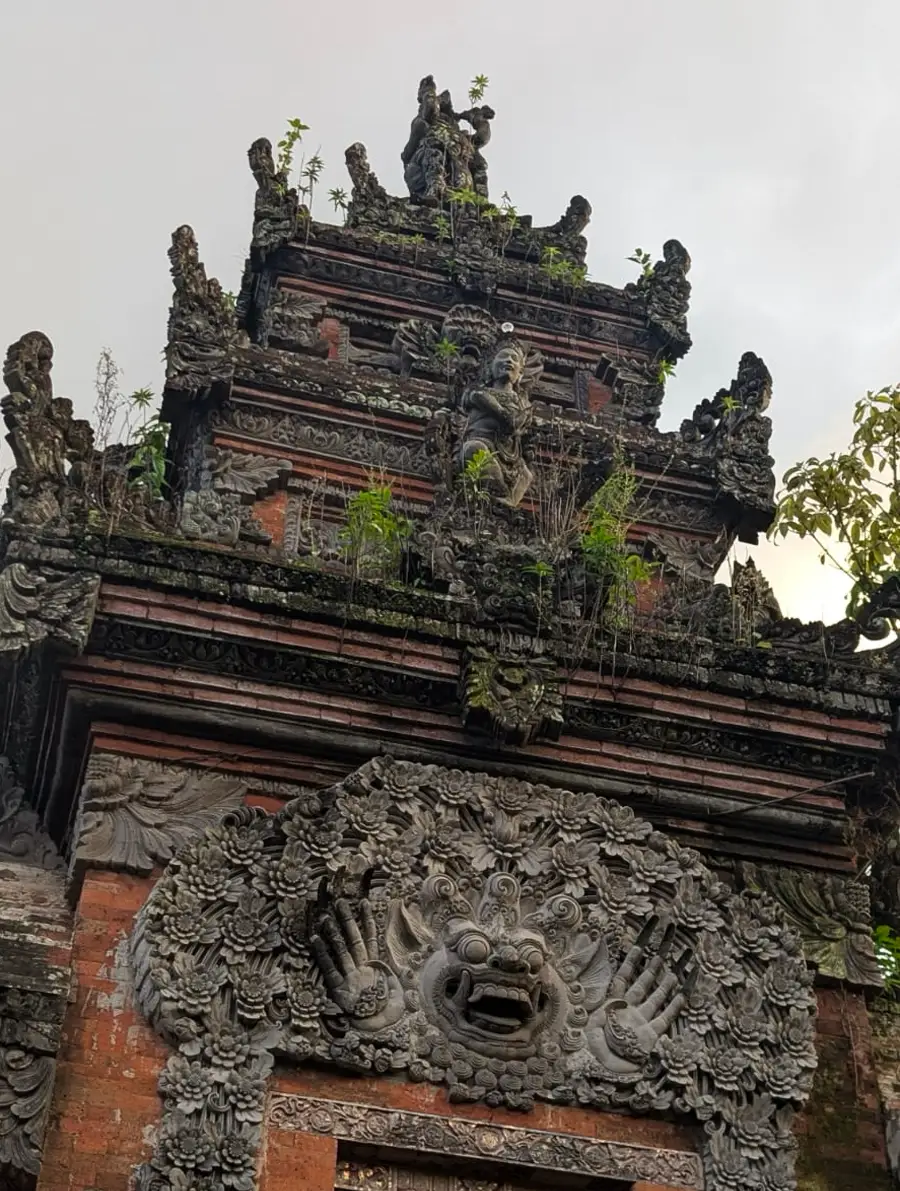
Om Swastyastu. Griya Gede Mas is the home of a Brahmana priest family in Mas, Ubud. The family descends from Danghyang Nirartha, the priest who came to Bali in 1489 and was received in Mas by Ki Pangeran Mas.
- Descended from
- Danghyang Nirartha, through his son Ida Putu Kidul
- In Bali since
- Saka 1411, 1489 AD
- Griya built by
- Ki Pangeran Mas
- Written by
- Ida Bagus Putu Eka Jaya Wibawa Putra, S.Pd., M.Ag., from the Griya's own sources
May there be no obstacle. I bow before God as Sang Hyang Trayodasa Saksi, the thirteen witnesses, and before the stars and the planets, for I speak of the line of descent.
Ya Tuhan, semoga tiada halangan. Sembah hamba pada duli Tuhan dalam manifestasi sebagai Sang Hyang Trayodasa Saksi, dan juga bintang dan planet-planet, sebab hamba menyebutkan tentang keturunan.
Ida Bagus Putu Eka Jaya Wibawa Putra, S.Pd., M.Ag.
The line of descent
KawitanThe line begins on Java, with priests of the kingdoms of Kediri and Majapahit.
-
KediriMpu Baradah
A great priest in the time of King Airlangga and a follower of Mahayana Buddhism, of unequalled spiritual power, who knew the way of creation and dissolution.
His children: Mpu Siwagandhu, Dyah Wedawati and Mpu Bahula.
-
KediriMpu Bahula
He married Dewi Ratna Manggali, the daughter of Mpu Kuturan and Calon Arang, Rangda Nateng Dirah.
Their children: Mpu Tantular, Mpu Dewiadnyani, Mpu Amerthajiwa, Mpu Dewi Dwarasika and Mpu Dewi Amertha Manggali.
-
MajapahitMpu Tantular
He carried on the Mahayana teaching. A gifted speaker who lived the essence of the teachings, he was purohita, priest and adviser to the king, of Majapahit, also called Wilwatikta.
His sons: Danghyang Panawasikan, Danghyang Sidhi Mantra, Danghyang Smaranatha and Danghyang Kepakisan.
-
DahaDanghyang Smaranatha
He lived in Daha and followed his father as purohita of Majapahit. With his wife, Dewi Dyah Sunyawati, he raised his two sons as keepers of the Brahmana way, trained in tapa, brata, yoga and samadhi, and in pasuk wetuning bhuwana, the creation and dissolution of the universe.
His sons: Danghyang Angsoka and Danghyang Nirartha.
-
Java to BaliDanghyang Nirartha
As a grown man he turned from the path of the Buddha, Buddhapaksa, to the path of Siwa, Siwapaksa, following Siwa Smerti. From there he developed Siwa Siddhanta, in which Buddhist and Siwa philosophy meet.
-
Mas, BaliIda Putu Kidul
Also called Buk Cabe. The son of Danghyang Nirartha and I Gusti Ayu Mas Gumitir, and the ancestor of the family of Griya Gede Mas.
The journey to Bali
Saka 1411 · 1489 ADDanghyang Nirartha set out for Bali with his wife and his seven children, and landed on the island in Saka 1411, 1489 AD.
Ida Ayu Swabhawa
Ida Kulwan (Wiraga Sandhi)
Ida Wayahan Lor (Ida Manuaba)
Ida Wiyatan (Ida Wetan)
Ida Istri Rai
Ida Telaga Ender
Ida Nyoman Keniten
- Perancak
He first rested under an ancak tree. The temple there is Pura Perancak.
- The forest
Crossing a dense forest, he was stopped by a monkey. Moved by his pure heart, the monkey showed him the way.
The naga and the three lotuses
In the forest he saw a naga with its mouth wide open, as if to swallow him. Through his purity he entered its mouth, and in the belly of the naga he found a lake with three lotus flowers in bloom.
- Whitein the east
- Redin the south
- Blackin the north
He placed the red and the black lotus behind his ears, held the white one in his hand, and came out of the naga chanting mantras. His body had changed colour. Seeing his face changed, his wife and children fled into the forest. He went after them and found them.
To his eldest, Ida Ayu Swabhawa, he taught the secret knowledge of moksa, which removes all impurity, and she became a goddess, Bhatari Melanting. Her temple is Pura Melanting. His wife wished for the same grace and became Bhatari Dalem Ketut, honoured at Pura Agung Pulaki.
- Gading Wani
The village was struck by an unknown disease. He healed its people with his spiritual power, and they named him Ida Pedanda Sakti Wawu Rauh, the powerful priest who has just arrived. He taught them tattwa, the truth, and the knowledge of religion.
- Mundeh
Travelling east towards Mas, he passed Mundeh. From his blessing on the village came Pura Resi Mundeh.
- Taman Sari
Further east he found trickling water and flowers in bloom. There he chanted holy mantras and sat in samadhi. The place is now Pura Taman Sari.
- Mas
News of Ida Pedanda Sakti Wawu Rauh reached Ki Pangeran Mas.
In Mas
Guru and sisyaKi Pangeran Mas went out to meet Danghyang Nirartha and his children. So began the bond of teacher and student, guru and sisya. Thirsting for the teachings, Ki Pangeran Mas received them with bhakti, devotion.
From a sincere heart he built Danghyang Nirartha a beautiful griya, with a pond and flowering trees, named Pura Taman Pule. Danghyang Nirartha loved to live there.
When his teaching was complete, Ki Pangeran Mas offered his daughter, I Gusti Ayu Mas Gumitir, as his wife. Their son, Ida Putu Kidul, also called Buk Cabe, is the ancestor of the family of Griya Gede Mas.
Danghyang Nirartha became known for his spiritual power and was made purohita of the kingdom under Dalem Waturenggong.
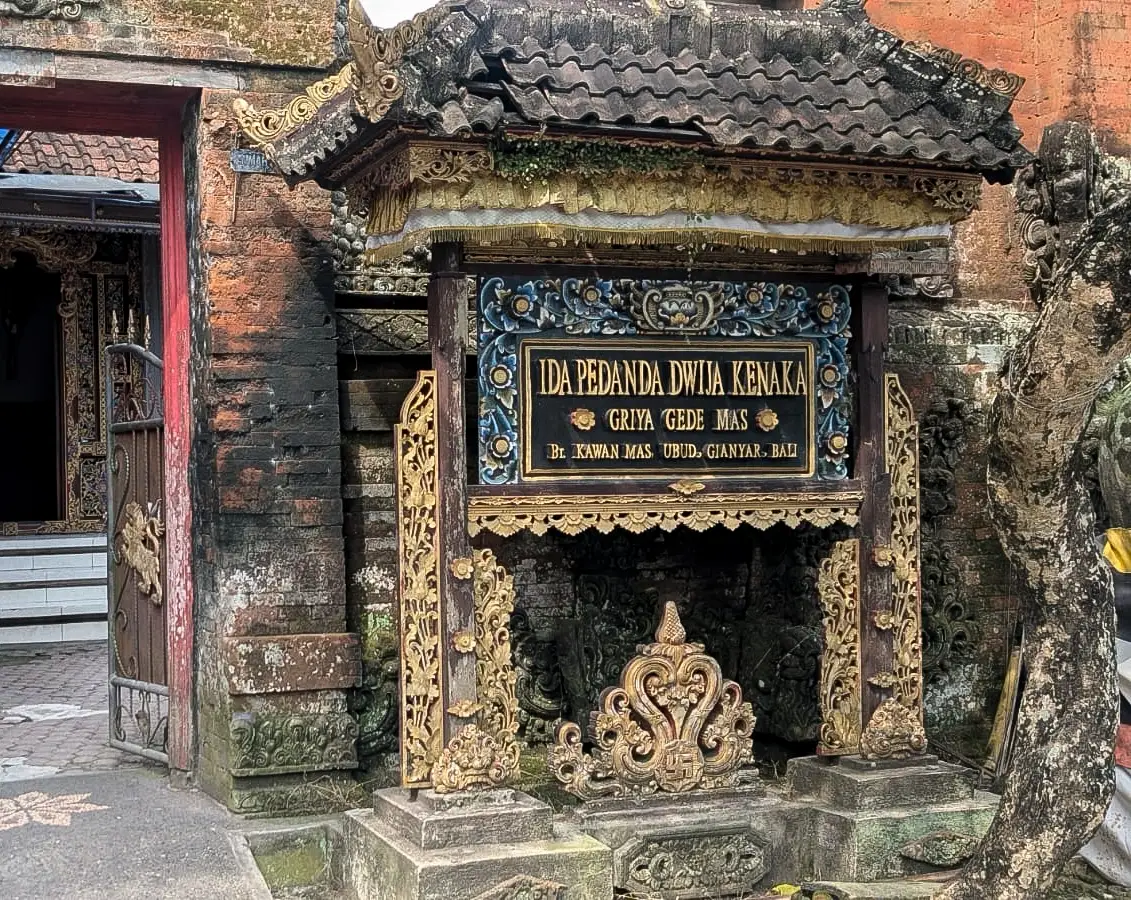
Temples of his journey
PuraAlong his journey temples were raised in his honour, among them:
- Perancak
- Melanting
- Agung Pulaki
- Gading Wani
- Rambut Siwi
- Amertha Sari
- Indra Kusuma
- Prapat Agung
- Jati
- Srijong
- Resi Mundeh
- Taman Sari
- Luhur Pakendungan
- Tanah Lot
- Goa Gong
- Batu Bolong
- Puncak Tedung
- Sakenan
- Taman Pule
- Er Jeruk
- Tugu
- Tengkulak
- Silayukti
- Ponjok Batu
- Suranadi
- Dalem Gandamayu
- Puseh Kamasan
- Masceti
- Petitenget
- Uluwatu
- Pesimpangan Melanting
- Melanting Dadia
- Agung Kayu Putih
- Samong
- Dalem Kemenuh
- Pamuteran Kemenuh
- Puseh Kemenuh
- Banyucitra
- Pagentengan
- Astakemude
- Puncak Bukit Manik
- Bukit Manuaba
- Bukcabe
- Bukit Aceh
- Sekaton
- Bukit Lingga
- Bajing
- Batu Lepang
- Bukit Bangle
- Taman Limut
The word griya
Giri · ya · grhaGiri means mountain. Ya is a sacred syllable that points to Siwa. A griya is the mountain where Siwa dwells.
A griya is also a grha, a house: the home of a Brahmana family, a place of spiritual service, and the home of a sulinggih, a priest who is Siwa sekala, Siwa in visible form.
The three courts
Tri MandalaTraditional Balinese architecture lays out sacred ground in three levels of sanctity. Together they trace a person's way from open ground to the most sacred place.
- Nista MandalaBhurloka · the outer court
- Madya MandalaBwahloka · the middle court
- Utama MandalaSwahloka · the family temple
Nista Mandala
Bhurloka · the outer courtThe outermost court receives guests and holds the everyday work: welcoming visitors, preparing ceremonies and the tasks around them. It stands for the outside world, the first step onto sacred ground.
Kori Agung
The great gate. Its inscription, in Latin letters, is the Griya's name in disguise:
AUM YANG WIT STRIDESA BRAHMANA WASTISTA WURU JUE PEKIK KENCANA GERIYA GEDE MAS
- Aum Yang
- O God
- Wit
- the ancestors, whose blessing is asked
- Stridesa
- wedded to a daughter of the bandesa
- Brahmana Wastista
- who brings forth a Brahmana line
- Wuru
- Ida
- Jue
- from jwa: small, the youngest child
- Pekik
- from apekik: handsome
- Kencana
- gold, Mas: Ida Mas, the last son of Ida Bhatara Sakti
- Geriya Gede Mas
- at Griya Gede Mas
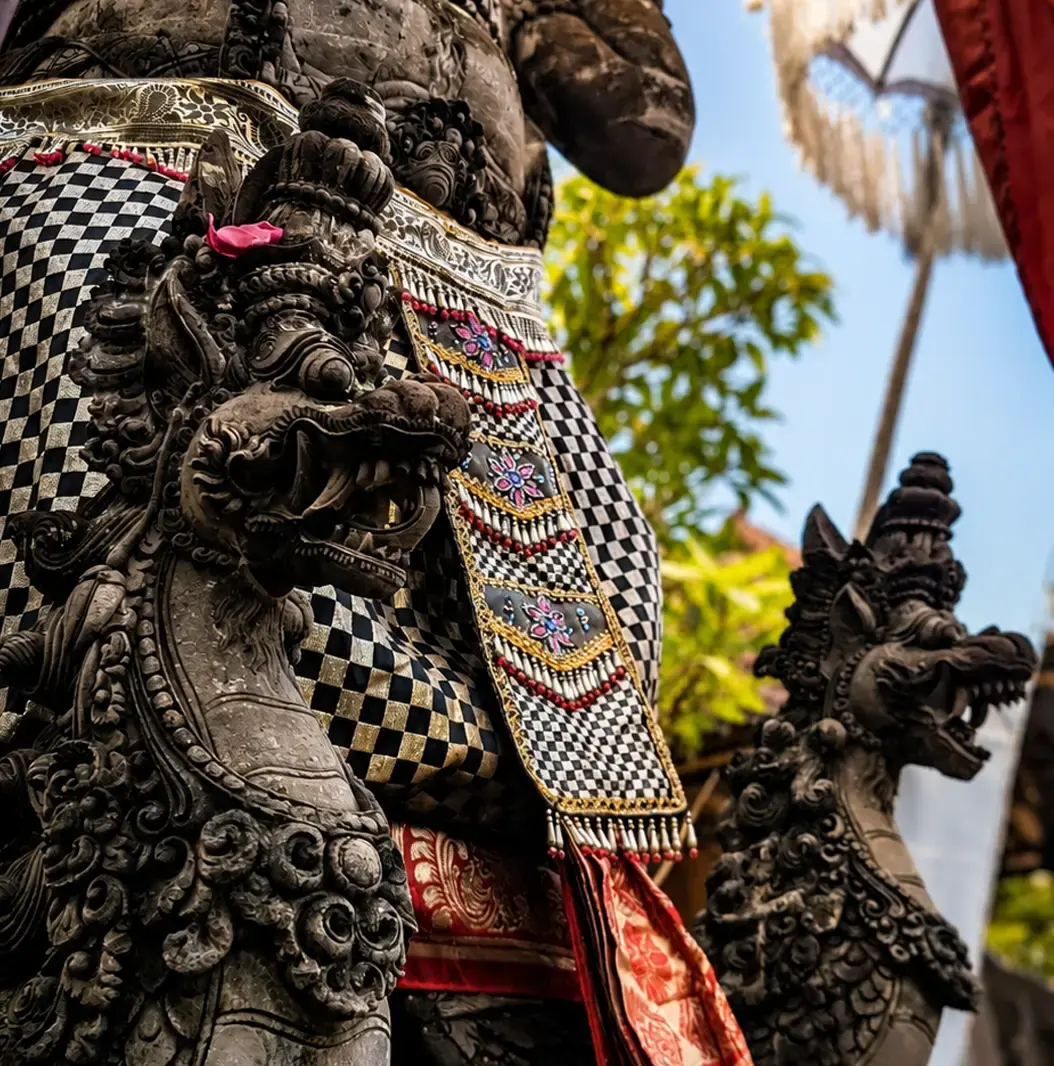
Dwarapala
On either side of the gate stand the Dwarapala, guardians of the Griya's sanctity. They are not there to frighten. They remind everyone who enters to come with good intention, a clean heart and respect for the Griya.
Bedawang Nala
Below lies Bedawang Nala, the cosmic turtle of Hindu teaching that holds up the universe. In Bali it is a reminder that all life stands on the balance of nature, and a symbol of mastering the forces of nature so that harmony can grow.
Madya Mandala
Bwahloka · the middle courtThe middle court joins the outer court to the most sacred one. Here the family lives and prepares its ceremonies. It stands for the purification of the self before entering the main court.
Gedong Daja
North, kaja, is the honoured direction, facing the mountain where the holy powers dwell. Gedong Daja holds the place of honour among the buildings.
Gedong Loji
Traditionally the store for valuables, ceremonial things and the family's needs. Its place in the west is a reminder to guard material wealth with wisdom, within dharma.
Bale Gede
Also called Bale Dangin, on twelve pillars: the pillar of truth that grows in this Griya. It serves ceremonies and family gatherings, and the rites of a person's life, such as tooth filing and ngaben, the cremation. The east, where the sun rises, stands for the beginning of life, for knowledge and for purity.
Gedong Dangin
Part of the living quarters. It completes the balance of the layout, so that daily life runs in harmony with spiritual life.
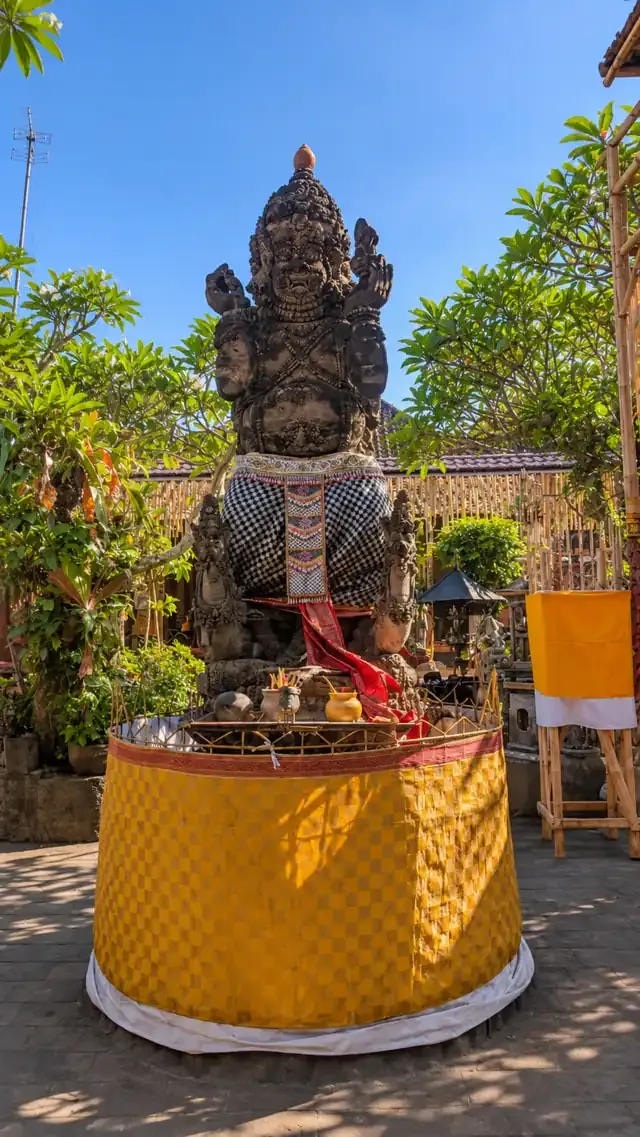
Arca Catur Muka
In the centre of the middle court stands the Arca Catur Muka, a statue with four faces: Brahma, the Creator. The faces look to the four directions, because the wisdom, knowledge and love of God reach the whole universe, whatever the direction or rank.
Brahma is a mighty form of Siwa, known as Siwa Sadasiwa, the ground of the world of Siwa. He is lord of the beings of the world, king of priests, and spreader of light.
Utama Mandala
Swahloka · the family templeThe most sacred court. Here stand the shrines of the family temple, for the worship of Ida Sang Hyang Widhi Wasa, His manifestations and the ancestors. It is entered with respect, pure in body and mind, and with proper conduct.
At its entrance the Dwarapala stand again. They guard the sanctity of the place, not only its gate, and remind whoever enters to have first purified:
- Manacikathought
- Wacikaword
- Kayikadeed
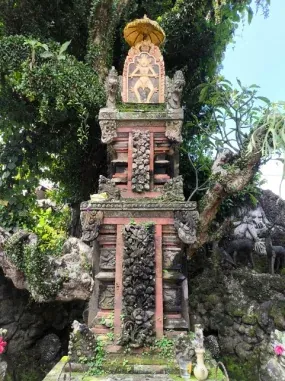
Padmasana
The highest shrine of the Utama Mandala: the holy seat of Ida Sang Hyang Widhi Wasa in His power beyond all form, Paramasiwa, Sadasiwa, Siwa. It stands highest because God is the highest aim of life, and it turns the mind, the heart and devotion upward.
Gedong Kawitan
The shrine of the first ancestor, the kawitan, in devotion and gratitude for the line that passed on life, dharma and tradition. In Balinese Hinduism, honouring the ancestors is part of pitra rna, the sacred debt to those who came before.
Kamulan Agung
The shrine of origin and of the family's unity, where the purified ancestors are worshipped. Every life comes from one source, and the family keeps its unity, its harmony and its inheritance of dharma.
Piayasan
The sacred pavilion where the offerings, banten, are prepared and presented during ceremonies. An offering is made with sincerity, a pure heart and bhakti, not for its form alone.
Dates carved in stone
CandrasangkalaAcross the Griya, years of the Saka calendar are carved in pictures, a candrasangkala.
-
Saka 18111889 AD
Behind the Padmasana
Four panels, no longer in their first place, carved with the moon goddess, an elephant and two human figures. They also bear the words sarohe, hatu, byan, mbun, not yet identified.
-
Saka 18511929 AD
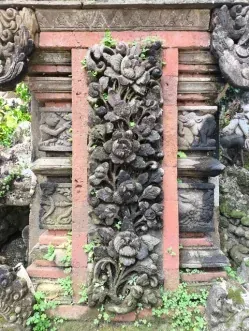
The Padmasana
In the family temple: a human figure, an elephant, an arrow and a bird.
-
Saka 18551933 AD
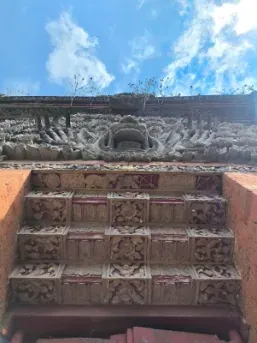
The Kori Agung
On the dedanga ulap-ulap, the inner north side of the gate, Balinese script and pictures: the sun, an elephant and arrows, with the words pawangun Ida Bagus Gde. The gate was built by Ida Bagus Gde.
-
Saka 18841962 AD
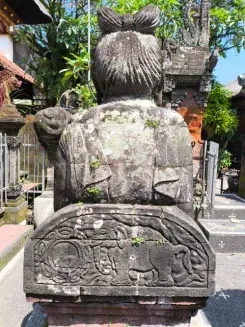
Arca Apit Lawang
The statues at the gate of the family temple: the sun and an elephant, and an elephant and water.
- On the aling-aling, the wall behind the Kori Agung, Balinese script is carved on the back of a crab relief: kapi parwa, taun. ne. ka. cat pet. cat. Its meaning is still being traced.
- Behind the wall of the Padmasana, ten panels of padas stone were found, some still in the ground, each carved with ten lines. A few words have been read, such as ong awighnamastu wigraha, and a date of issue. The rest waits for an auspicious day to be conserved.
Written by Ida Bagus Putu Eka Jaya Wibawa Putra, S.Pd., M.Ag., from the Griya's own sources.
Plan your visit
A temple tour walks through the three courts, from the Kori Agung to the family temple. Ayutyas in Sukawati, 15 to 20 minutes from the Griya, arranges visits in English. Send your dates and the number of people.
- Where
- Griya Gede Mas, Br. Kawan, Mas, Ubud
- Bookings
- Ayutyas, +62 821 4400 2161
- Price
- Shared on WhatsApp